
💡Are we plugging the future into the past?
The 130-year-old mistake we may be repeating ...

Artificial Intelligence transformation in enterprises is not just a matter of adopting new technology, it is a journey in un-learning, re-thinking, re-imagination, and re-architecture.
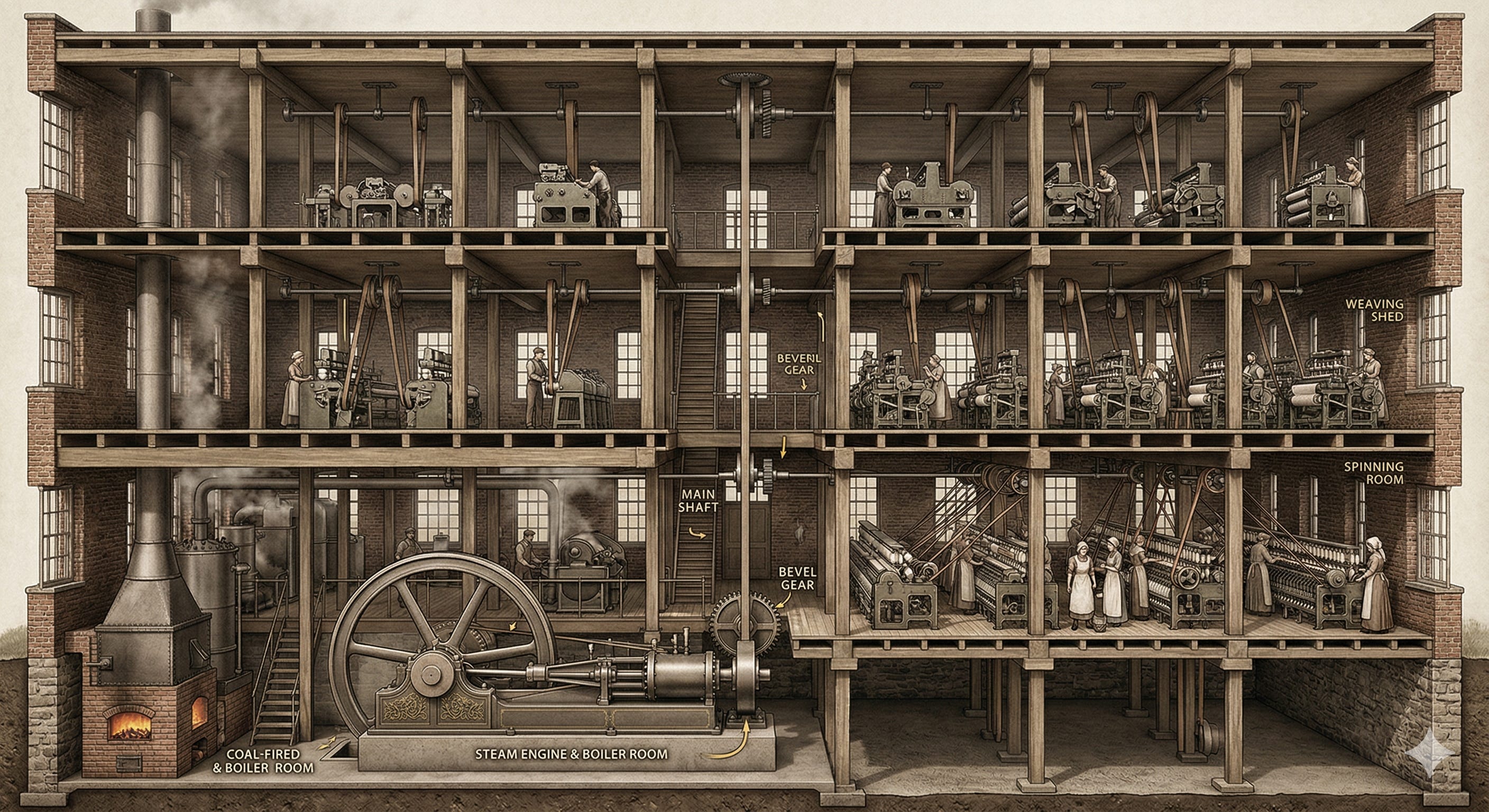
In the late 1800s, factories ran on steam. One massive engine sat in the basement, and its power radiated outward through a web of belts, shafts, and pulleys running along ceilings, connecting every machine on every floor.
The factory floor wasn’t organized around the flow of production. It was organized around the flow of the belt. Heavy machines sat close to the main shaft because long belts lost energy. Floors were stacked vertically, not because multi-story buildings made workflow sense, but because vertical shafts distributed power more efficiently than horizontal ones.
The architecture of the entire factory was a slave to the physics of power transmission.
The motor arrives. Nothing changes.
When the electric motor appeared, factory owners did the obvious thing. They took out the steam engine and dropped an electric motor in its place. Same basement. Same shafts. Same belts. Same building.
For roughly thirty years, from the 1890s through the 1920s, the productivity gains were underwhelming. The electric motor was clearly superior. Cleaner, more reliable, easier to start and stop. Yet factories weren’t meaningfully more productive.
The problem wasn’t the motor. It was the belt.
The real unlock was architectural
The breakthrough came when a new generation of designers asked a different question. Instead of “how do we replace the engine with the motor?”, they asked: “if every machine can have its own motor, why do we need belts at all?”
Without belts, machines didn’t need to cluster around a central power source. Factories could be single-story, spread horizontally, organized around the actual flow of work. You could start and stop individual machines independently. Rearranging the floor no longer meant re-engineering the power distribution system.
The term for this is unit drive, each machine gets its own motor. It sounds mundane. It was transformative.
Why belts survived
The resistance wasn’t technical. Factory owners had massive capital invested in multi-story buildings. Foremen understood the old system. Maintenance crews knew how to repair it. Every role, habit, process, and norm was built around keeping those leather arteries flowing.
Removing the belt meant rethinking the building, the layout, the org chart, the skills, the workforce, capital allocation, even what a factory looked like. The belt was comfortable. The belt was understood. The belt was the problem.
AI is the electric motor of our time
This brings us to the AI transformation happening right now. We have the motor. But are we keeping the belts?
Some questions worth sitting with:
If AI can resolve customer issues in seconds, why does the response still travel through the same ticketing workflow, the same SLAs, the same escalation paths designed for human teammates?
If AI coding assistants generate code 2-10x faster, should that code still enter the same pull request queue, wait for the same number of reviewers, follow the same checklist designed when humans typed every line?
If AI models can assess transaction risk in milliseconds, why do we still route decisions through human-in-the-loop review layers built for rule-based systems? Model flags, human reviews, another human approves.
If AI compresses days of research and analysis into minutes, why does the output still flow into the same document templates, the same presentation formats, the same weekly review meetings that stretch it out?
If AI can generate prototypes, test variations, and synthesize user feedback at scale, why do product teams still follow the same stage-gated roadmaps and quarterly planning cycles? The speed of insight has changed. Has the speed of decision?
Why belts survive
Belts survive because they encode decisions, they create roles, and they are legible to leadership. The belt has delivered value. It is trusted. Removing a belt means giving up organizational wisdom, and renegotiating all of that, and that is harder than adopting any technology.
Skeptics aren’t wrong when they say that AI productivity gains haven’t fully materialized. They are just looking at the wrong thing. The motor works. The belts are the bottleneck.
The thirty-year question
It took an entire generation for the full productivity gains of electrification to materialize. Not because the technology was slow, but because the organizational and architectural adaptation was slow.
The question for all of us right now: Does the AI transformation allow us to ignore history? How will we learn from the factory owners who didn’t just swap the engine, but reimagined the factory?
The motor was never the hard part. The belts are the hard part. The belts are always the hard part. What belts are we holding on to?
Brilliant analogy, Sri. I think the deeper issue is that most organizations do not change this radically unless survival demands it.
Covid was the clearest modern example. Scarcity of time, resources, and optionality compressed decision cycles, shortened governance lifecycles, reduced institutional drag, and forced people to focus on what actually mattered: getting something meaningful into the world fast. In those moments, the organization does not have the luxury of protecting every belt.
That is why AI transformation feels slower than its technical potential. Many firms are still trying to route an exponential capability through waterfall-era operating models, long approval chains, oversized handoffs, and too many people in the path to production. The motor is fast, but the pipeline is still optimized for caution, not learning.
My suspicion is that the real gains from AI will show up first in smaller, cohesive teams of capable people with a bias for action, high accountability, and the humility and growth mindset to keep learning fast. People who do not just know their narrow lane, but understand the domain and business end to end; how value is created, where friction sits, what the customer experiences, and what really matters in production. That kind of context changes AI from a task accelerator into a system redesign capability.
Fewer people in the pipeline. Fewer handoffs. Less choreography. More ownership.
For large orgs, one practical answer may be AI-native incubators: startup-like environments inside the org that reimagine an entire product or business lifecycle end to end; from idea, to build, to decisioning, to shipping, to customer usage and feedback. Not as innovation theatre, but as proof of what "beltless" execution actually looks like.
The challenge for incumbents is not whether AI works. It is whether they can create enough necessity, focus, and structural freedom to redesign around it before a crisis does it for them.
Insightful post, Sri. Interesting analogy. I think most of the SDLC is automated in many companies thanks to the DevOps wave in the last decade. The bottleneck in big companies seems to be the need for executives to sign off before launches. Because of the fear of something going wrong in production.